Language is best learnt through active use
A linguist once claimed that you could learn a language, say Danish, by adding 6 new words to your vocabulary every day. In a year, you would thus have a vocabulary of around 2190 words, and considering that a kindergarten teacher uses roughly 470 words in her daily interaction with staff and children, 2190 words go a long way.
I'm certain that the idea of learning 6 new words a day isn't entirely off the marker, but, unfortunately, the truth is that language is best learnt by using it in everyday situations, and by acquiring a deep knowledge of the society that language originated in - giving substance to your newly learnt language.
Taking an interest in Danish society is important
Learning a language depends to a large extent on your needs and interests. Taking an interest in Danish society, in how Denmark works compared with your home country, or other countries you may know of, is important.
Taking an interest in how this country works, with respects to democracy, freedom of expression, equal rights, the economy, etc. is a wonderful thing. What does democracy mean here, compared with your country of origin? What do Danes mean when they speak of freedom of expression, or equal rights, or ...?
Some years back, I visited a seventh grade class in Hvidovre during a social studies class. They were discussing civic rights. At one point, the teacher wrote on the blackboard: Do, what you think is best for you. Immediately, what sprung to my mind was the importance of all multilingual parents knowing what that phrase - the foundation of the modern public school education theory - means in Denmark. In many places around the world, parents still make the decisions on what is right for their children. The teachers' job is simply to provide the children with the necessary academic accomplishments.
If I, Adil Erdem, had presumed to know what was best for myself, disregarding my parents' opinion, I should probably have been locked up in my grandmother's house indefinitely. While academic accomplishments are, of course, important in Denmark, what's even more important is teaching young people to think for themselves. We teach them to make their own decisions, to have the courage to contradict others and to reason with them, and to take responsibility for their own lives.
Get involved in your child's education
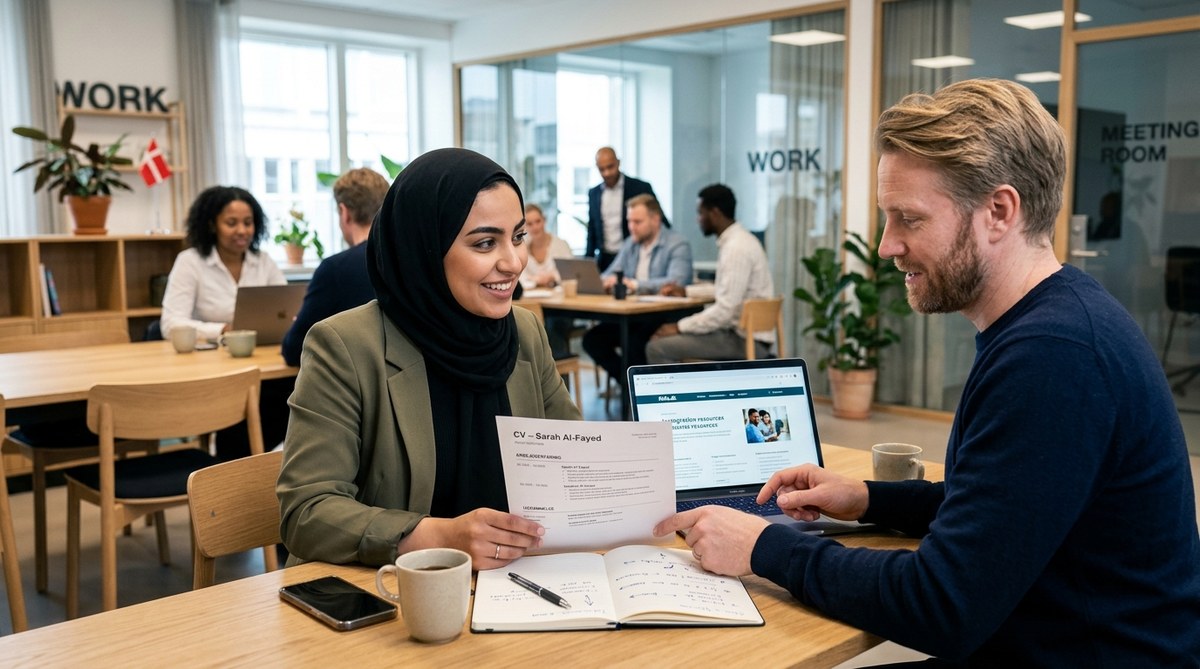
If you have, or plan to have, school-age children, getting involved in their education will also get you a long way towards mastering the Danish language. Your child's school bag is chuck full with language and knowledge that can help you learn Danish, and learn about Danish society as well. Numerous letters go out to parents every week, updating them on their children's activities, and what is expected of the parents.
By taking the time to understand the principles behind modern education theory, you can gradually grow to accept that your little girl of seven won't grow up to be exactly like you. - you might as well accept that the world is different in these parts. Learning Danish will help you here. You should learn Danish - not, perhaps, in order to land your dream job or get your preferred education, but in order to be the kind of mother who understands her children's thoughts, dreams, and activities. Hoping that your children will grow up to be exactly like you is a recipe for disaster. So: learn 6 new words every day, and supplement this by practicing your Danish through the documents you will find in your child's school bag, and through the parent-teacher relationship.
Find friends, and learn Danish by cultivating your interests.
I am convinced that a lot of our life experience and learning is somehow dependent on our general interests. Interest in literature - for instance H.C. Andersen - swimming, football, cooking, dance, music, etc. I don't mention H.C. Andersen because he is Danish, but because he is one of the world's great writers. His wellspring is the Danish language, and you have the opportunity to read him in the original.
Some people learn Danish exclusively for this purpose. My first thought is that reading H.C. Andersen is a voluntary interest, but it becomes almost mandatory for multilingual parents with young children. There's no getting around the fact that H.C. Andersen is part and parcel of children's culture, along with a lot of the great writers multilingual parents themselves were raised with in their country of origin.
Sometimes, people ask me: "how do I find Danish friends?" I didn't really have an answer until I started thinking about how I got my own friends. It turned out to be simple. First, I mapped out my interests and who I was as a person: I was a writer, father, football fan, tennis player, and took an interest in politics. I realised that it was probably no coincidence that most of my friends were writers, parents, tennis players, and politically interested. Talk to people you know about your interests, learn how to express them in Danish.
I had a Danish teacher almost twenty years ago, who told me that you can't learn a new language unless you are happy in your life, and don't have a thousand problems to wrestle with along with learning Danish.
Forget about grammar - at least initially
Many who attempt to learn Danish as a second language complain about the grammar. I understand them completely, but it's important to realise that learning grammar and learning a language are not the same thing. You will only choke and get discouraged, if you expect your grammar to be flawless from day one. Therefore, it is a good idea to begin using the language at first, and worry about correct grammar later on. The best grammar instruction you can get may well come from your mother tongue. Try comparing the grammar of your mother tongue with the one you hear in Danish - but don't expect to master Danish grammar in an afternoon or two of comparative studies. You will need a proper Danish course in order to master the grammar - particularly if your knowledge of the grammar of your mother tongue isn't all that.
Learn Danish by using your mother tongue
Learning the grammar isn't the only use for the mother tongue. I distinctly remember a language learner who came up to me and proudly announced that she had stopped reading books in her mother tongue. She did this because she wanted to speed up learning Danish. I told her that her strategy worried me. It worried me because, basically, using and developing the mother tongue will aid you in learning new languages as well. A large part of learning a new language is having a solid basis for drawing comparisons with your mother tongue. The more, say, tales from the Arabian Nights you read in Arabic, the easier you will find it once you get to reading H.C. Andersen in Danish.
Read, read, read
A lot of magazines are published in Denmark, covering almost any topic, from parenthood to sports, cars, and literature. Most of these are characterized by covering a wide field of interests, and being written in a language that is not too hard to handle. If this type of reading is not your cup of tea, you need look no further than your local library. Here, you will find an abundance of books on any topic, including novels by Danish authors. If you have a hard time meeting Danes in your daily life, novels are an excellent place to absorb knowledge of the language, the people, and their customs. This type of reading can really boost your confidence.
Learn Danish at a language school
Finally, I want to stress the importance of learning Danish at a language school if at all possible. This will ensure that you learn correct grammar and usage. And remember that learning is for life - you have to keep up your newly learnt language at every opportunity.
The above is a revised version of a Danish article originally written by Adil Erdem.